

The banjo, with its unmistakable percussive twang, is a beautiful and distinctive string instrument. Across the musical worlds of folk, blues, bluegrass, and traditional music, its presence is widely felt – and never to be missed. However, unlike its more famous six-string sibling, the guitar, it is not so easy to find resources and guidance on learning to play the banjo. In fact, most music stores in the UK – apart from the most specialist ones – hardly even stock them. And then there is the challenge of finding yourself a banjo lesson after that. Yet, it is not impossible. So, if your dream is to become a virtuosic banjoist, don’t give up just yet. This musical instrument deserves to have so many more players than it does – and, here, we’re going to show you how you can join the ranks of the banjo players yourself.
Key Takeaways
- The banjo is a distinctive string instrument known for its bright, percussive tone and drone sound, widely used in folk, bluegrass, and traditional music.
- Most banjos have five strings, though the tenor banjo used in Irish music typically has four strings and is played with a pick.
- The instrument’s unique sound comes from strings vibrating over a membrane head attached to a circular rim, rather than a wooden body like a guitar.
- Popular banjo playing styles include clawhammer, Scruggs-style bluegrass, and Irish tenor banjo picking.
- Famous banjo players such as Earl Scruggs and Béla Fleck helped shape modern banjo music and technique.
- Beginners can start learning the banjo with simple tuning, rhythm patterns, and folk songs, often progressing quickly with regular practice and lessons.


What is the Banjo?
We’re going to run through some of the key aspects of the banjo that you need to know – from its history to its physiognomy to its most famous and respected players and performances. And then we’ll show you how you can actually expect to find a banjo teacher where you are. As we said, it is far from impossible. With some basic knowledge and a heap of commitment, you’ll be a proper banjo player in no time. So, let’s take a look. And, by the way, you can learn about playing the lute!

The banjo produces a distinctive, bright sound because of its construction. Unlike most string instruments, the strings vibrate over a stretched membrane head attached to a circular rim. This design creates the instrument’s sharp, percussive tone and the characteristic drone sound heard in bluegrass, folk, and traditional American music. The result is a sound that stands out clearly in a band alongside guitars, fiddles, and bass.
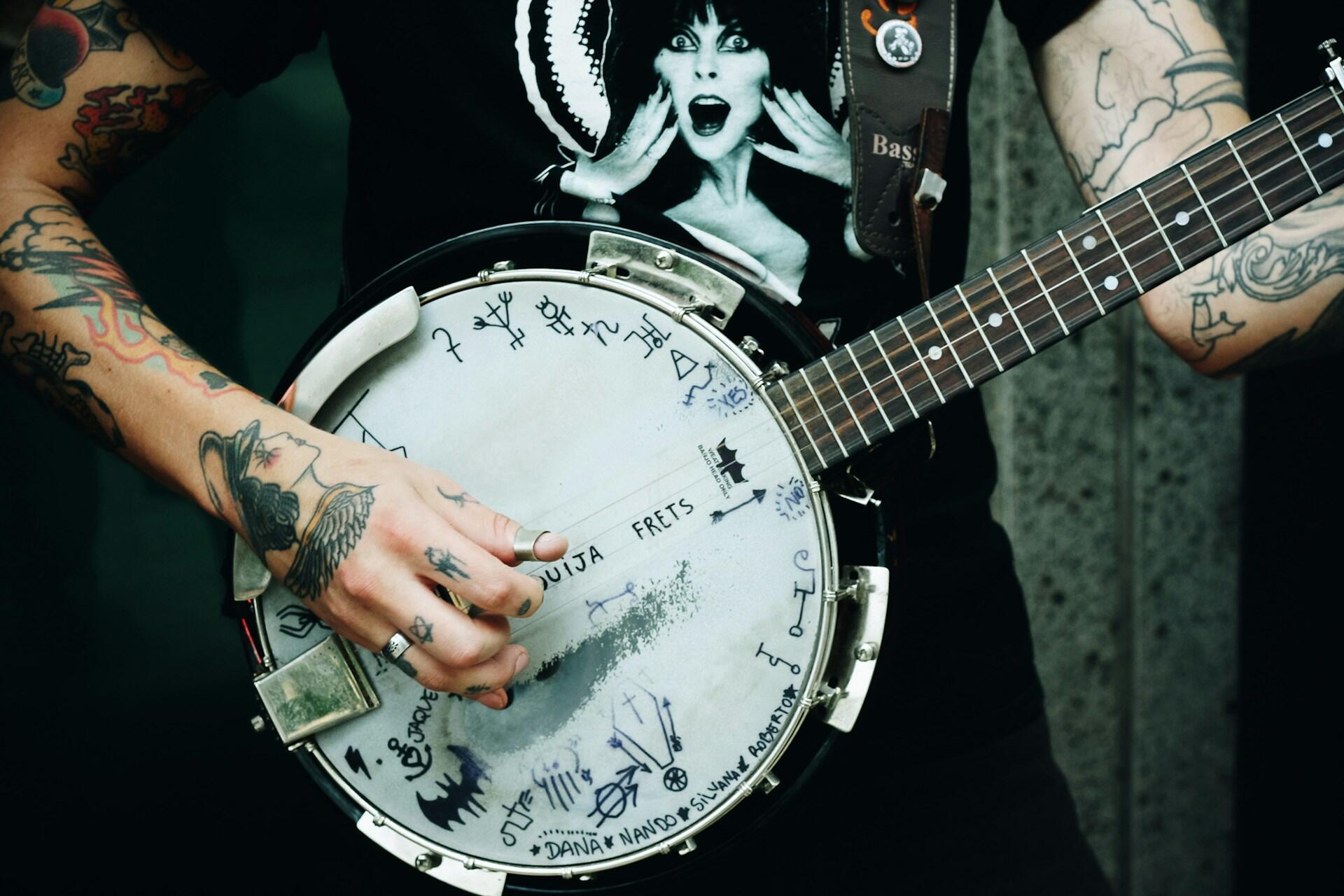
Even if you’re a total beginner, you’ve certainly heard a banjo – and probably seen one too. It’s perhaps one of the most characteristic instruments of American traditional music – developed by the African-American slave community before being appropriated by the white population – and, these days, it characterises the world of folk music. It’s easily recognised: four, five, or six strings that are stretched over the instrument’s ‘head’, a circular frame over which a plastic – or, more traditionally, animal skin – membrane is stretched. The result is a string instrument that produces a percussive, plucked sound, often with an underlying drone.
How Many Strings on a Banjo?
As we said, the banjo’s number of strings can vary, and they are usually found with four, five, or six different strings. Despite these variations, the ‘normal’ or standard banjo has five strings. Usually, on the five-string banjo, whilst the rest of the strings stretch from the tuning nuts at the top to the bridge at the bottom, the fifth string starts from the fifth fret. This means you have a string ready to play whichever higher notes you might want.
strings, with the shorter fifth string used to create the drone sound.
The four-string banjo might seem like something played like a bass guitar, but it is actually much more like a ukulele. You will play it like a uke – but, predictably enough, it will sound like a banjo. Something similar applies to the six-string banjo. However, it plays less like a ukulele and more like a normal six-string guitar. It retains its banjo sound, of course. Ever thought about learning the ukulele?
Are There Different Types of Banjos?
The main distinction among banjos is the number of strings. However, there are a number of niche instruments that suit particular playing styles, which we will outline below. Something perhaps more important that you should be aware of first, though, is the resonator. On the head of a banjo – the instrument’s round body – is the plastic membrane through which the sound is produced. However, picture the other side of that body. Sometimes, this is left open. If so, this is called, quite predictably, an ‘open-backed’ banjo.
Most banjos come in two main designs: open-back and resonator. Open-back banjos have no wooden plate on the back of the rim, giving them a softer sound often used in clawhammer and old-time folk playing. A resonator banjo includes a wooden back that projects the sound forward, producing a louder and brighter tone. Because of this extra projection, resonator banjos are the preferred instrument for bluegrass players.
The alternative is that the back is covered with a plate called a resonator. These produce a much louder sound, and the tone is heavier and punchier. If you are playing bluegrass – one of the most famous genres for the banjo – you’ll be wanting a resonator banjo. Meanwhile, here are some of the other major types of banjo:
- Plectrum banjo. We know that the five-string banjo usually has one string shorter. Take this away, and you have what is called a plectrum banjo, which is usually played with a plectrum.
- Tenor banjo. Popularised by the banjoist from the Dubliners, the tenor banjo is an Irish development. A shorter neck and a particular tuning, the Irish tenor banjo is usually used as a rhythm instrument.
- Bass and cello banjo. These are much lower in pitch and were developed for banjo orchestras, believe it or not.
strings and is typically played with a pick.
Check out the mandolin whilst you are here!
Famous Banjo Performances
The history of the banjo is long. However, given its popular roots, the instrument's early practitioners are not well known. In fact, it is in the twentieth century that the banjo became the famous – although alternative – instrument it is now. Here are two of the most famous banjoists of the twentieth century – as well as another band that purists won’t like…
Earl Scruggs
Referred to as the father of bluegrass and one of the most important banjo players ever to have graced the planet, Earl Scruggs changed the way that people played the banjo. With his famous ‘Scruggs style’ – a three-fingered style that came to define bluegrass music – he influenced generations of banjo players.
Béla Fleck
Of all contemporary banjo players, the Grammy award-winning Béla Fleck has done most to take the instrument out of its particular niche and apply it to all manner of musical styles. With his virtuosic style, his penchant for jazz licks, and his absurdly talented band, the Flecktones, Fleck has given new life to the instrument.
Mumford & Sons
We did tell you that the purists wouldn’t like this. Whilst Mumford & Sons aren’t exactly the most inventive of musicians, they have done music a great favour by popularising the banjo sound – at least in the UK. These days, you can’t be a folk band without a banjo – and that’s thanks to this country-inspired pop band. Find out about different types of string instruments!
How to Play the Banjo: Essential Banjo Techniques
Many guitarists often assume, because they can play a plucked string instrument, that they can play all of them. This isn’t exactly true, as the banjo has a number of specific techniques that are quite different from standard guitar playing.

Clawhammer
One of the most distinctive of banjo techniques is the clawhammer technique. This is notable for the fact that, when playing, you don’t pick upwards with your fingers, but rather downwards. Obviously, you won’t recognise this from the guitar. Get your hand into a claw-like shape and move it from the wrist (you don’t want to flick your fingers independently). This technique produces one of the most characteristic sounds of the banjo.
Scruggs Style
The typical bluegrass sound, Scruggs style, is played with fingerpicks on the thumb and the first two fingers. You’ll want to alternate each in a ‘rolling’ pattern of arpeggios. With the Scruggs style, a melody is interwoven into the arpeggios, resulting in a fast, often swung or syncopated rhythm.
Irish Banjo Playing
One of the easier techniques for a beginner to learn is the Irish style of banjo playing. This is done usually with a pick, like a guitarist’s, and is usually played on a four-string tenor banjo.
Where to Get Banjo Lessons
Now, the most important part of your musical learning journey is to find a banjo teacher. An instrument teacher is, without doubt, the most important person in your musical education – apart from you, of course – so make sure you choose them wisely, whether you're learning the banjo or the cittern. Your banjo player should be able to show the basic techniques, musical theory, and songs, for sure. But they should also inspire you to take an interest in everything about the instrument – and get you discovering your own favourite elements.
Week
Learn the Instrument Basics
Start by understanding the banjo’s parts, including the strings, neck, rim, and tuning pegs. Learn how to hold the instrument properly and practise basic tuning so the banjo produces a clear tone.
Weeks 2–3
Learn Basic Chords and Rhythm
Begin practising simple chord shapes and rhythm patterns. Many beginners start with basic folk or bluegrass songs, which help develop timing and familiarity with the banjo’s distinctive sound.
Weeks 4–6
Practise a Playing Style
Choose a style to focus on, such as clawhammer or Irish tenor banjo picking. At this stage, players begin developing finger coordination and learning simple melodies.
Months 2–3
Play Complete Songs
With regular practice and lessons, most beginners can play full songs by this stage. You will start to develop confidence, improve timing and tone, and explore more complex banjo techniques.

A common beginner question is “is the banjo hard to learn?” While advanced styles like Scruggs-style bluegrass playing require speed and coordination, beginners can learn basic rhythm patterns quickly. Many players start with simple clawhammer patterns or tenor banjo picking before moving on to faster techniques. With regular practice and the right guidance, most beginners can start playing simple folk or bluegrass tunes within a few weeks.
Find a Banjo Tutor on Superprof
One of the best places to find a banjo tutor is through Superprof, our platform that connects students with tutors from across the world. We have 12 tutors available for online lessons who will sit with you and show you everything you need to know to excel on your instrument.
Head to Your Local Music Store
If you're in a town with a music store, one of the best places to find instrument lessons is right there. Just pop your head in and ask. Be aware, however, that the banjo is not like the guitar. Not every man and his dog can play and teach the banjo.
for an entry-level banjo.
Check Out Banjo Resources Online
The internet is a great place to learn new skills – and that includes learning the banjo, too. You’ll find tablature, video tutorials, and all manner of other things online. So, if you have a banjo ready to be played, go and get started.
Summarise with AI:
Did you like this article? Leave a rating!

 Loading...