
Celtic symbols are some of the most recognisable forms of art and design. Spirals, knots, crosses, harps, shamrocks, and rings are often used to symbolise life, strength, love, protection, faith, and cultural identity. They feel timeless, but there's often more to them than meets the eye. Let's explore.
Key Takeaways
- Celtic symbols often represent ideas such as life, strength, unity, protection, balance, and spiritual connection.
- Irish symbols and Celtic symbols can overlap, but they are not always the same thing.
- Some Celtic symbols have strong historical roots, while others have meanings shaped by modern interpretation.
- The triskelion, triquetra, Celtic Cross, Dara Knot, Ailm, and Wheel of Taranis are key symbols in Celtic-inspired design.
- The shamrock, Claddagh Ring, and harp are especially important Irish symbols with strong cultural significance.


Historical Background of Celtic Symbols
Several important Celtic symbols are found in ancient art, monuments, and material culture, including artistic traditions associated with La Tène culture.¹ Some early designs appear in prehistoric sites before later Celtic and medieval styles developed. This long history helps Celtic symbols feel ancient, mythological, and deeply connected to the land.
years ago.⁵
Certain symbols have remained largely unchanged with deep historical roots. Others are modern interpretations of older artistic traditions.
Celtic symbols are often linked with life, strength, unity, protection, and the sacred power of nature. Some of these meanings are supported by ancient art, archaeology, mythology, and medieval Christian tradition. Others come from later Irish culture, revival movements, jewellery design, tattoos, and modern spiritual interpretation. The safest way to understand Celtic symbols and their meanings is to look at both historical evidence and the modern meanings people attach to them.
Key Celtic Symbols and Their Meanings
Common Celtic symbols include spirals, knots, crosses, wheels, and natural forms. Some are connected to medieval art, mythical creatures, and tradition, while others draw on modern inspiration to shape their current forms. Celtic art can represent life, strength, unity, protection, balance, and spiritual connection.
The triskelion and the triquetra are both three-part designs, but they are not the same Celtic symbol. The triskelion is usually formed from three spirals or curved arms, while the triquetra is an interlaced triangular knot. Both are often associated with balance, movement, unity, and the rhythm of life. However, their meanings depend on context, and modern interpretations should not always be treated as fixed ancient beliefs.
Three-part designs appear often in Celtic symbolism. However, these are not all the same image. They are best understood separately, even when they share similar qualities.
prehistoric passage tombs of Knowth, Newgrange, and Dowth.⁵
Triskelion (Triskele)
Triquetra (Trinity Knot)
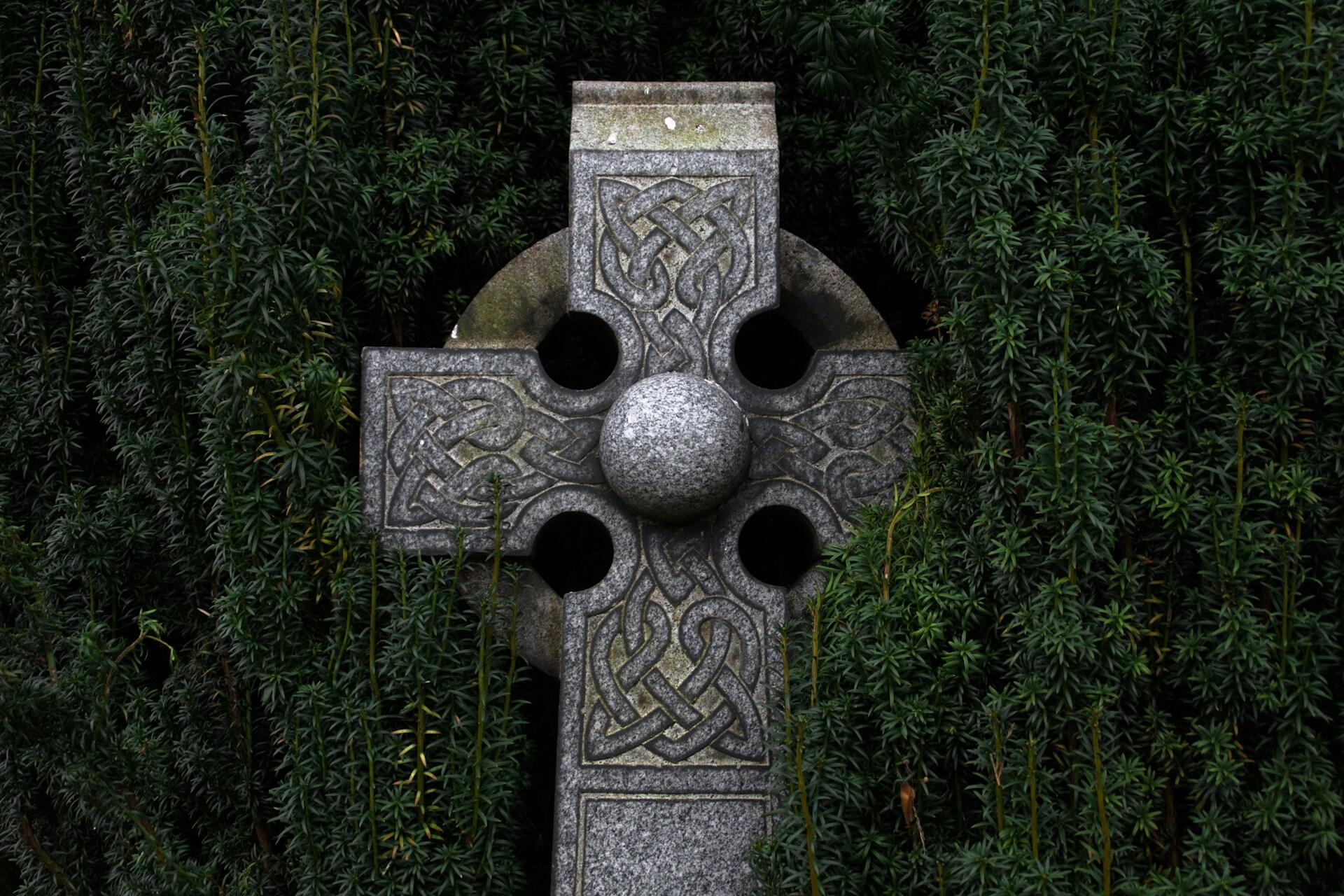
Celtic Cross
Dara Knot
Ailm
Wheel of Taranis
Irish Symbols and Their Cultural Significance
Irish symbols and Celtic art can sometimes overlap, but they are not always the same thing. Some Irish symbols are rooted in national identity, religion, music, folklore, jewellery, and everyday cultural life. Their cultural importance makes context especially important when discussing their meanings.
The shamrock is one of the most famous Irish symbols, especially because of its association with St Patrick. Many people know the tradition that St Patrick used the shamrock to explain the Holy Trinity. However, the National Museum of Ireland explains that this story belongs to a later tradition rather than firm evidence from Patrick's own lifetime.⁸ This makes the shamrock a powerful Irish symbol, but one whose popular meaning developed over time.
Shamrock
Claddagh Ring
Harp
years.³
| Symbol | Common Meaning | Historical Context | Irish Connection | Careful Note |
|---|---|---|---|---|
| Triskelion / Triskele | Movement, growth, and life cycles | Spiral forms appear in ancient Irish stone art | Strongly associated with prehistoric Irish sites such as Brú na Bóinne | Exact ancient meanings are not fully recorded |
| Triquetra / Trinity Knot | Three-part unity and balance | Known from interlaced Insular and Celtic-style art | Often seen in Irish jewellery, art, and modern Celtic design | Modern meanings vary widely |
| Celtic Cross | Faith, eternity, and the meeting of heaven and earth | Irish high crosses are major early medieval monuments | One of the most recognisable Irish Celtic symbols | The circle has several interpretations |
| Dara Knot | Strength, endurance, and rootedness | Modern knot design inspired by the oak tree and Celtic knotwork | Popular in Irish-inspired tattoos and jewellery | Its ancient status is less secure than older carved symbols |
| Ailm | Strength, resilience, and clarity | Connected with the Ogham letter name Ailm | Used today in modern Celtic and Irish symbolic design | The original meaning of the Ogham letter is uncertain |
| Wheel of Taranis | Power, thunder, and divine force | Taranis was a Celtic thunder deity associated with the wheel | More broadly Celtic than specifically Irish | Best treated as a pan-Celtic symbol |
| Shamrock | Ireland, faith, and good fortune | Linked with St Patrick traditions and Irish identity | One of the best-known Irish symbols worldwide | The St Patrick Trinity story is a later tradition |
| Claddagh Ring | Love, loyalty, and friendship | Early examples date to around 1700 | Originates from the Claddagh tradition in Galway | More Irish cultural symbol than ancient Celtic symbol |
| Harp | Ireland, music, and national identity | Irish harping has a tradition of more than 1,000 years | Official emblem of the Irish State | An Irish symbol rather than a Celtic knot symbol |
Integration of Celtic Symbols in Modern Culture
Celtic symbols are popular for both their aesthetics and their meaning. Because they can carry personal, artistic, spiritual, and cultural significance, many people continue to use them in new contexts, from fashion to tattoos. Today, these symbols appear far beyond traditional settings.
Celtic knots, Claddagh rings, triquetras, and crosses are widely used in rings, pendants, bracelets, and earrings.
Many people choose Irish Celtic symbols for tattoos because they can represent strength, love, protection, family, spirituality, or personal heritage.
The harp is used as an official emblem of the Irish State and appears on Irish coins.⁴
Celtic symbols are common in Irish gift shops, visitor centres, postcards, clothing, and decorative objects.
Modern artists still use Celtic knots, spirals, crosses, and interlaced patterns to connect contemporary design with ancient and medieval traditions.
Celtic symbols are often chosen for gifts, memorial pieces, wedding jewellery, and family objects because they can represent connection across generations.
References
- Encyclopaedia Britannica. “La Tène Culture.” Encyclopaedia Britannica, 20 Apr. 2026, https://www.britannica.com/topic/La-Tene-culture. Accessed 26 June 2026.
- Encyclopaedia Britannica. “Taranis.” Encyclopaedia Britannica, https://www.britannica.com/topic/Taranis. Accessed 26 June 2026.
- Government of Ireland. “Irish Harping Recognised by UNESCO as Irish Living Heritage.” Gov.ie, Department of Culture, Communications and Sport, 13 Dec. 2019, https://www.gov.ie/en/department-of-culture-communications-and-sport/press-releases/irish-harping-recognised-by-unesco-as-irish-living-heritage/. Accessed 26 June 2026.
- Government of Ireland. “The Harp.” Gov.ie, Department of the Taoiseach, 11 Apr. 2025, https://www.gov.ie/en/department-of-the-taoiseach/publications/the-harp/. Accessed 26 June 2026.
- Heritage Ireland. “Brú na Bóinne Visitor Centre: Newgrange, Knowth and Dowth.” Heritage Ireland, https://heritageireland.ie/places-to-visit/bru-na-boinne-visitor-centre-newgrange-knowth-and-dowth/. Accessed 26 June 2026.
- Heritage Ireland. “High Crosses.” Heritage Ireland, https://heritageireland.ie/articles/high-crosses/. Accessed 26 June 2026.
- National Museum of Ireland. “Claddagh Rings.” National Museum of Ireland, https://www.museum.ie/en-IE/Collections-Research/Folklife-Collections/Folklife-Collections-List-%281%29/Other/Curators-Choice/Claddagh-Rings. Accessed 26 June 2026.
- National Museum of Ireland. “St. Patrick.” National Museum of Ireland, https://www.museum.ie/en-IE/Collections-Research/Folklife-Collections/Folklife-Collections-List-%281%29/Religion-and-Calendar-Customs/St-Patrick. Accessed 26 June 2026.
- National Museum of Ireland. “The Banagher Cross Shaft.” National Museum of Ireland, https://www.museum.ie/en-IE/Collections-Research/Irish-Antiquities-Division-Collections/Irish-Antiquities-Articles/The-Banagher-Stone. Accessed 26 June 2026.
- University of Glasgow. “Ogam and Trees.” OG(H)AM: Harnessing Digital Technologies to Transform Understanding of Ogham Writing, 20 Dec. 2022, https://ogham.glasgow.ac.uk/index.php/2022/12/20/ogam-and-trees/. Accessed 26 June 2026.
Summarise with AI:
Did you like this article? Leave a rating!

 Loading...